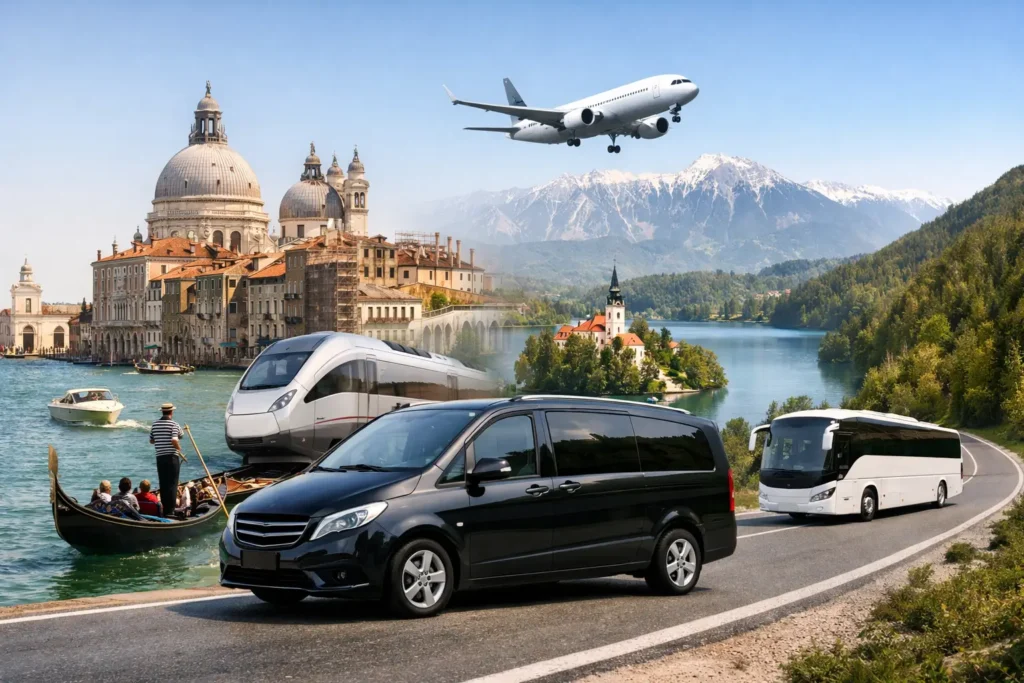
Landing in Venice and needing to be in Slovenia on time changes the way you choose transport. A Venice to Slovenia transfer is not just about distance – it is about border logistics, luggage, timing, and how much uncertainty you are willing to accept after a flight, cruise arrival, or business meeting.
For some travelers, the cheapest route works. For others, especially if the destination is Ljubljana, Koper, Portoroz, Postojna, Bled, or a business address with a tight schedule, the better choice is the one that removes friction. That is where the real difference between trains, buses, rental cars, and private transfers becomes clear.
What makes a Venice to Slovenia transfer different
On a map, the trip looks straightforward. In practice, it depends on where in Venice you start, where in Slovenia you are going, and how precise your arrival time needs to be.
Venice Marco Polo Airport, Venice city center, Mestre, and cruise terminals all create different pickup realities. Slovenia is not one single endpoint either. Reaching Ljubljana is different from reaching the coast, and getting to a hotel in Piran is not the same as arriving at a business office in Koper or a resort near Lake Bled.
Cross-border travel adds another layer. Public transport often works best station to station, not door to door. If you are carrying multiple bags, traveling with children, arriving late, or coordinating with colleagues, a simple route can quickly become a chain of separate steps.
Private Venice to Slovenia transfer
A private transfer is usually the strongest option when punctuality, comfort, and direct routing matter more than shaving every possible dollar off the trip. You are picked up at the airport, hotel, apartment, or port and driven directly to your address in Slovenia without changing vehicles along the way.
That matters more than many travelers expect. After a delayed flight, the value of having a driver waiting, helping with luggage, and handling the border route is very different from standing in line for tickets or trying to coordinate train and bus schedules in a language you do not speak confidently.
Private service also makes sense for groups. When two, three, or four people travel together, the gap between public transport costs and a direct car transfer often narrows. Add the time saved and the reduced stress, and the premium starts to feel practical rather than indulgent.
For business travelers, the benefits are even clearer. A direct car gives privacy for calls, predictable pickup timing, and a cleaner arrival experience. If your destination is a conference venue, office, factory, or hotel outside a major station area, door-to-door service is hard to match.
This is the reason many travelers book with providers such as Taxi Nova through https://taxinova.si when they want a more polished regional transfer experience rather than a standard local taxi.
Train from Venice to Slovenia
The train appeals to travelers who are comfortable with connections and have flexible timing. It can be a pleasant way to travel, especially if you are moving light and heading to a city that is easy to reach from the rail network.
The trade-off is coordination. Direct rail options are limited, and many journeys involve changing trains or combining rail with another leg by bus or taxi. That may be perfectly manageable for a solo traveler on a relaxed itinerary, but it becomes less attractive after a long-haul flight or when arrival time matters.
Train travel also works better for central station arrivals than for final destinations on the Slovenian coast or in smaller towns. If you still need another ride after the station, the total trip may take longer than expected and cost more than the original rail fare suggests.
Bus and shuttle services
Buses can be budget-friendly, and for some routes they are straightforward. If your schedule aligns with available departures and your destination is close to the drop-off point, a bus may be enough.
Still, buses ask more from the passenger. You need to work around fixed departure times, baggage policies, and the possibility of waiting after your flight lands. If the bus stop is not near your final address, you are back to arranging another ride at the end.
Shared shuttle services sit somewhere in the middle. They can be more convenient than a large bus, but they are rarely as direct or as predictable as a private car. Multiple passenger pickups and drop-offs can add time, especially during busy travel periods.
Rental car for a Venice to Slovenia transfer
Driving yourself gives freedom, and some travelers prefer it. If you plan to continue around Slovenia for several days, a rental can make sense.
But the freedom comes with responsibilities. Cross-border rental terms vary, parking can be inconvenient, and airport pickup queues are not unusual during peak periods. After a long flight, navigating unfamiliar roads and local driving rules is not always the relaxing start people imagine.
There is also the question of what kind of trip you actually want. If you only need a one-way Venice to Slovenia transfer, renting a car may create extra admin, fuel costs, parking fees, and return planning that a direct transfer avoids.
Which option is best for your trip?
It depends on what you are optimizing for.
If the goal is lowest upfront cost, bus or rail may work. If the goal is flexibility for a longer self-drive vacation, a rental car has value. But if the goal is reliable timing, direct routing, professional pickup, and a comfortable ride after an airport arrival or before an important meeting, private transfer usually comes out ahead.
That is especially true for travelers going beyond the obvious city-center routes. Destinations such as Piran, Portoroz, Izola, Koper, Ljubljana suburbs, or resort properties are much easier when the driver already knows the route and delivers you to the exact address.
Families often prefer private service because child seats, luggage space, and fewer transitions make the day easier. Older travelers appreciate not having to manage stairs, platforms, or multiple handoffs. Corporate travelers value discretion and control over timing.
Timing, border crossings, and real-world travel conditions
One of the most common planning mistakes is assuming the trip length is fixed. It is not. Traffic near Venice, seasonal congestion, cruise schedules, event traffic, and weekend travel patterns can all affect the route.
Border movement is usually manageable, but it can still influence overall travel time. Professional transfer providers account for that in a way that first-time visitors often cannot. They know which timing windows tend to be busier and which routes are more practical based on current conditions.
This is one reason fixed public timetables do not always feel efficient in real travel conditions. A route that looks fine online can become inconvenient if your incoming flight is late or your connection leaves little room for error.
When premium transfer service is worth it
Not every trip requires a premium car service. If you are traveling solo with one backpack, staying overnight in Venice, and reaching a station-friendly destination in Slovenia the next day, public transport may be completely reasonable.
But there are clear cases where private transfer earns its place. Late-night arrivals, early departures, executive travel, family trips, cruise connections, and airport pickups with checked baggage all benefit from a more controlled experience.
The same goes for travelers who simply do not want the trip to become a project. There is value in being met on time, riding in a clean vehicle, and arriving without the small frustrations that tend to pile up across a cross-border journey.
How to book the right transfer without overpaying
The smartest bookings start with the full route, not just the headline price. Ask what is included, where the pickup happens, whether wait time is covered for airport arrivals, and whether the vehicle fits your luggage comfortably.
It is also worth confirming who the service is designed for. Some operators function like basic taxi dispatch. Others are built around pre-booked regional transport with higher service standards, multilingual communication, and drivers used to airport and business schedules. The difference shows up in reliability more than in marketing language.
A good transfer should feel organized before the ride even begins. Clear confirmation, easy communication, and confidence around timing matter just as much as the vehicle itself.
If you are planning a Venice to Slovenia transfer, choose the option that matches the value of your time, not just the price of the seat. The smoothest trip is usually the one you barely have to think about once it starts.