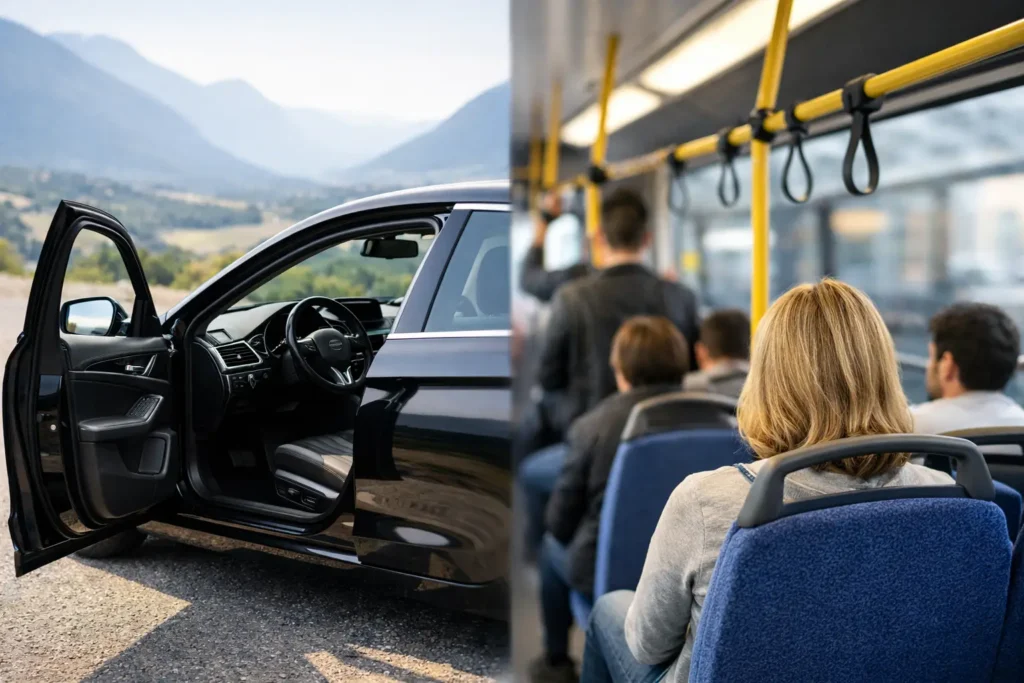
A 6:10 a.m. flight, a suitcase, and a hotel outside the city center can turn a simple transfer into the most stressful part of a trip. The choice between private ride versus public transport is not only about the ticket price. It affects when you leave, how much luggage you can bring, whether you arrive composed, and how easily you can adapt when plans change.
For travelers moving through Slovenia, Italy, and Croatia, the right option often depends on the route. A train or bus can be an excellent choice for a direct daytime journey between major city centers. A private transfer becomes more valuable when the trip involves an airport, a border crossing, a business schedule, a coastal address, or several people traveling together.
Private Ride Versus Public Transport: Start With the Journey
Public transport works best when the network matches your plans. If you are staying near a station, traveling light, and have flexibility in your schedule, it can be a practical and economical way to get around. Major routes between central Ljubljana, Trieste, Venice, and other well-connected locations may offer frequent departures during the day.
The calculation changes when the journey has multiple moving parts. An airport arrival can be delayed. A late-night landing may fall outside regular service hours. A hotel, villa, meeting venue, or ferry terminal may require another taxi after the train or bus. Each connection adds time, handling, and the possibility that one missed departure affects the next.
A private ride is built around the passenger rather than a fixed route. The driver collects you at the agreed location, assists with luggage, and takes you directly to the destination. That is especially useful when the priority is certainty rather than simply getting from one city to another.
Airport Transfers: Time Is More Than Travel Time
For airport travel, the published journey duration rarely tells the whole story. Public transport requires time to reach the station, wait for the service, manage platforms or stops, and complete the final transfer at the other end. An early flight can mean leaving much earlier than expected, particularly if the first available bus or train does not align with check-in time.
With a pre-booked private airport transfer, pickup is arranged around your flight and location. You do not need to search for a platform after a long flight, work out a ticket machine in an unfamiliar language, or hope there is room for luggage during a busy period. For families, travelers carrying sports equipment, or passengers arriving with several bags, that direct service can remove a great deal of friction.
This does not mean public transport is always the wrong choice. A solo traveler with a daytime flight and a hotel beside a direct rail link may find it perfectly suitable. The deciding factor is whether the savings justify the extra steps and less control over timing.
Comfort, Privacy, and the Ability to Work
Business travelers often judge transportation by what it allows them to do before arrival. A crowded train or bus can be fine for a short, informal trip. It is less useful when you need to review a presentation, make a confidential call, or arrive at a client meeting without the fatigue of navigating several connections.
A private vehicle provides a quieter, more controlled setting. You can travel with colleagues, prepare for the day, or simply take a break between flights and meetings. Professional drivers also understand that discretion matters. The value is not just a more comfortable seat. It is the ability to preserve focus and present yourself well when the journey is part of a working day.
Leisure travelers benefit in a different way. After arriving in a new region, a direct ride gives you time to settle in rather than decode local routes immediately. That can be particularly welcome after a late arrival in Trieste, a transfer from a Venice-area airport, or a trip toward the coast with children in tow.
The Real Cost Is Not Always the Fare
Public transport usually has the lower upfront price, especially for one passenger on a direct route. That advantage is real and should be considered. But a fair comparison includes the full door-to-door cost.
Think about the local taxi needed to reach a station, the price of separate tickets, possible luggage charges, and the final ride from the terminal to your accommodation. If two, three, or four people are traveling together, a private transfer may become far more competitive when the total is shared. The difference can be even smaller on routes where public options require multiple connections.
Time also has a cost. Missing a flight, arriving late for a meeting, or losing the first evening of a short vacation can outweigh the savings on a lower fare. For travelers with a fixed deadline, paying for a direct, reserved ride is often a sensible way to reduce risk.
Cross-Border Travel Rewards Simple Planning
Travel between Slovenia, Italy, and Croatia is one of the clearest cases where private transport can offer a meaningful advantage. Public networks do not always connect across borders as directly as a map suggests. Timetables may vary by season, routes may require transfers, and the last stretch to a smaller town or coastal property may be difficult without a car.
A private cross-border ride keeps the journey in one vehicle from pickup to arrival. There is no need to coordinate separate carriers, move bags between platforms, or work around a limited evening timetable. This is helpful for airport arrivals, conference travel, cruise connections, and holiday itineraries that combine more than one country.
It is also a better fit when plans are specific. Perhaps you need pickup in Koper, a meeting in Trieste, and an evening arrival in Northern Italy. Or perhaps your family is landing at an airport and heading directly to a Croatian coastal destination. Those are not impossible public-transport journeys, but they can involve more planning than most visitors expect.
When Public Transport Is the Better Choice
Choosing a private ride should not mean dismissing public transport. For central-city sightseeing, a frequent local bus, tram, or train can be efficient and easy. It avoids parking concerns and lets you travel as locals do. On a predictable daytime route with one traveler and little luggage, it can offer excellent value.
Public transport may also be the preferred choice if your schedule is open. If you are happy to spend an extra hour exploring a station area, wait for the next departure, or adjust plans around a timetable, the trade-off may feel worthwhile.
The key is to avoid applying one choice to every trip. Use the option that supports the purpose of that specific journey. A relaxed afternoon between city centers has different needs from a 4:00 a.m. airport departure or an executive transfer across a border.
When a Private Ride Is Worth It
A private transfer is often the stronger choice when punctuality is non-negotiable, when the pickup or drop-off is outside a major transit hub, or when comfort and privacy matter. It is particularly practical for early or late travel, airport connections, families and small groups, travelers with substantial luggage, and business guests with a schedule to keep.
Booking in advance adds another layer of confidence. Your transport is arranged before you land or before your meeting ends, rather than becoming another task to solve at the last minute. With 24/7 availability, multilingual coordination, and professional drivers, Taxi Nova is designed for travelers who want that certainty on regional and cross-border routes.
The best travel plan is the one that leaves enough room for the journey itself. If a direct ride means you arrive rested, on time, and ready for what comes next, it can be one of the simplest ways to make the entire trip feel better.