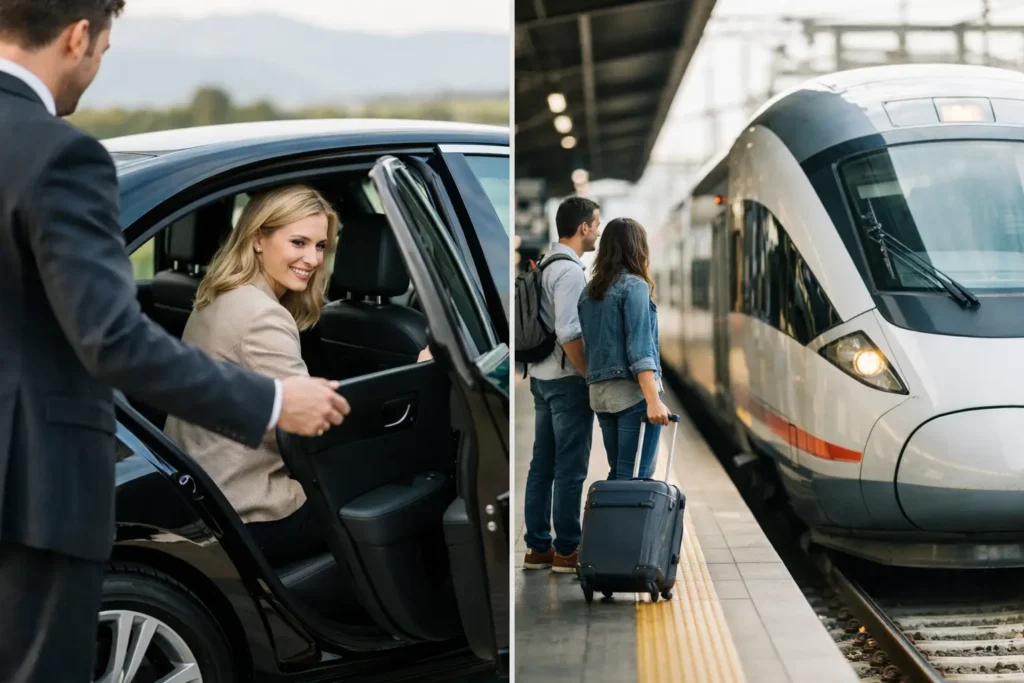
You land with a suitcase, a laptop bag, and a meeting in two hours. The question is not theoretical at that point – private transfer or train? For many trips across Slovenia and nearby parts of Italy and Croatia, the better option depends less on distance and more on timing, luggage, connections, and how much uncertainty you can tolerate.
Some travelers default to rail because it feels efficient and familiar. Others book a car immediately because they want the door-to-door certainty. Both choices can work well. The smart decision comes from knowing where each one performs best, especially for airport pickups, cross-border routes, business appointments, and holiday travel along the Northern Adriatic.
Private transfer or train for airport travel
Airport trips are where the difference becomes obvious very quickly. A train may be perfectly reasonable if your arrival city has a direct rail connection, your hotel is near the station, and you are traveling light. If all three line up, rail can be straightforward.
The problem is that airport travel rarely stays that tidy. Flights run early, late, and sometimes very late. Luggage takes time. Families move slower. Business travelers often need to go straight to an office, hotel, conference venue, or client address rather than a central station. In those cases, a private transfer reduces the number of moving parts.
With a pre-booked car, the route starts when you are ready, not when the timetable says so. There is no need to calculate transfer windows between terminal, shuttle, platform, and final taxi. That matters even more after a long flight, on an unfamiliar route, or when crossing into another country.
For airport pickups in particular, convenience is not just a luxury feature. It is time protection. If your day depends on arriving without delays or confusion, a private transfer usually gives you the cleaner plan.
Where trains make more sense
Trains still have real strengths, and it would be misleading to suggest otherwise. On well-served routes between major city centers, rail can be practical, comfortable, and cost-effective. If your departure and arrival points are both close to stations, and your schedule is flexible, the train may be the simplest option.
This is especially true for solo leisure travelers who are not carrying much and do not mind a short walk, local taxi, or public transit at the end. Rail can also be appealing if you enjoy the journey itself and prefer a less private, more open style of travel.
For daytime city-to-city trips, trains can offer a predictable rhythm. You board, settle in, and avoid road traffic. If your destination is directly connected and you are not under pressure, that can be a very reasonable choice.
The key limitation is that rail works best when your trip fits the network. Once your route involves airports, coastal towns, smaller destinations, business districts, or cross-border coordination, the balance often changes.
Comfort is not the same thing for every traveler
When people compare transport options, they often talk about comfort as if it means one thing. It does not. For some travelers, comfort means stretching out and reading. For others, it means privacy, climate control, quiet, and not sharing space with strangers.
A train can be comfortable in a broad sense, but it is still a shared environment. You work around station access, platform changes, carry-on handling, crowded departures, and the noise level of the carriage. If that does not bother you, fine. If you are heading to a meeting, traveling with family, or simply want a calmer experience, a private transfer offers a different level of control.
That is where premium transfer service stands apart from a basic ride. A clean vehicle, professional driver, luggage assistance, and direct routing remove a surprising amount of travel fatigue. The benefit is not only physical comfort. It is mental ease. You do not need to think about where to stand, which platform to use, or what to do if one segment runs late.
For executives, couples, older travelers, and small groups, that difference is often worth the extra cost.
Cost depends on how you measure it
At first glance, the train often looks cheaper. Sometimes it is. But ticket price alone does not always reflect the full cost of the trip.
Start adding the real details. You may need a taxi to the station, another ride from the station to your hotel or office, baggage handling, and extra time built in to protect against missed connections. If two or three people are traveling together, the cost gap can narrow quickly. For families or small groups, a private transfer may be more competitive than expected.
There is also the value of your time. A business traveler who loses an hour navigating transfers has paid for that delay one way or another. A family arriving tired with children may care less about saving a small amount and more about reaching the hotel smoothly. A couple on vacation may decide that a direct transfer at the start of the trip sets the right tone.
So yes, price matters. But the better question is total trip value, not just the cheapest visible fare.
Private transfer or train on cross-border routes
Cross-border travel is where rail can become less convenient than it first appears. Slovenia, Italy, and Croatia are closely connected in many ways, but transport logistics do not always feel simple on the ground. Timetables, station locations, route changes, and onward local transport can make a short regional trip feel more fragmented than it should.
A private transfer is often the cleaner solution when traveling between places such as Ljubljana, Koper, Trieste, Venice-area destinations, or Croatian coastal points. Instead of stitching together segments, you move directly from one address to another. That is especially helpful for international visitors who may not speak the local language, know the station layout, or want to manage transport after dark.
For business travel, this matters even more. If you are crossing a border for a meeting, event, cruise departure, airport connection, or hotel check-in, reliability beats improvisation. A professional transfer service can account for route planning, traffic patterns, pickup timing, and local coordination in a way rail simply cannot personalize.
When flexibility matters more than speed
People often assume the fastest option wins. In reality, the most useful option is usually the one that stays flexible when plans change.
Trains are fixed by design. That is part of their strength. It is also their weakness. If your flight is delayed, your meeting runs over, your child needs a break, or your check-out time shifts, a timetable does not adapt around you.
A private transfer gives you more room to handle the day as it unfolds. That can mean an early morning departure, a late-night airport pickup, an additional stop, or a schedule built around your exact appointment. For travelers who care about predictability, flexibility may be the more valuable form of speed.
This is one reason premium regional operators such as Taxi Nova appeal to travelers who do not want to leave important journeys to chance. The service is not just transport from point A to point B. It is a more controlled travel experience, which becomes increasingly valuable when the trip has consequences beyond getting there.
Which option is best for your type of trip?
For airport transfers, private cars usually make more sense, especially with luggage, children, late arrivals, or direct hotel drop-off. For business travel, private transfer is often the stronger choice because punctuality, privacy, and direct routing support the purpose of the trip.
For simple city-center routes in daylight, trains can work well if your schedule is loose and the stations are convenient. For cross-border travel, holiday routes, and regional destinations outside major rail hubs, private transfer often removes the friction that rail introduces.
For groups, the math often favors a car more than people expect. For solo travelers on a straightforward route, the train may be entirely adequate. The right choice depends on whether your priority is lowest headline cost or the smoothest overall experience.
The better question to ask before booking
Instead of asking whether rail or car is generally better, ask what your trip actually demands. Do you need direct pickup? Are you carrying luggage? Is your destination near a station? Are you traveling across a border? Is timing tight? Would one missed connection disrupt the day?
Once you answer those questions honestly, the decision becomes easier. Train travel has its place and can be an excellent fit on the right route. But when the journey needs to be punctual, private, and uncomplicated, a private transfer often proves to be the better investment.
The best travel choice is the one that leaves you focused on where you are going, not on how many steps it takes to get there.